


The Drayage Dispatch: December 13 - December 19, 2025

Drayage & Intermodal Weekly Update
Trade policy uncertainty is showing up in operational decisions, from inventory timing to equipment buying. On December 18, the Port of Los Angeles reported November volume of 782,249 TEUs, down 12% year over year after earlier frontloading, even as it projected finishing 2025 above 10 million TEUs. Long-horizon infrastructure bets continued on the East Coast, with the Port Authority of New York and New Jersey approving a 33-year lease extension at Maher Terminals through September 2063. Meanwhile, regulatory signals around autonomy and a steep slowdown in Class 8 retail sales point to an industry trying to keep optionality without committing too early.
Headlines & Key Takeaways
Union Pacific And Norfolk Southern File STB Merger
Union Pacific and Norfolk Southern filed an application with the Surface Transportation Board seeking approval to combine the two railroads. The companies said their nearly 7,000-page filing details how the merger would convert 10,000 interline lanes to single-line service and reduce an estimated 2,400 rail car and container handlings per day. Progressive Railroading.
Port Of NY/NY Extends Maher Lease
The Port Authority of New York and New Jersey approved a 33-year lease extension at Maher Terminals that would secure operations through September 2063. The agreement includes Maher taking full responsibility by 2030 for maintaining and rehabilitating wharf and berth structures within its leasehold, alongside rent incentives tied to capacity growth. The Maritime Executive.
Deep Dive: Drayage Market Shifts & Policy Updates
Tariff Uncertainty Meets Port Volume Reality
A CNBC report described tariffs reshaping how supply chains stock up for the holidays, and the Port of Los Angeles provided a real-time snapshot of what that volatility looks like at the gate. Port leadership said it still expects to finish 2025 above 10 million TEUs, despite year-over-year softness tied to earlier frontloading. FreightWaves. CNBC.
- The Port of Los Angeles processed 782,249 TEUs in November, down 12% year over year.
- Total traffic reached 9,447,731 TEUs through November, 1% ahead of 2024 with one month remaining.
- November loaded imports were 406,421 TEUs (-11% y/y), exports 113,706 (-8%), and empties 262,122 (-13%).
- The CNBC piece frames tariffs as a key driver of holiday inventory and ordering behavior.
Implication: Drayage planning gets harder when volume moves shift from steady seasonal patterns to policy-driven surges and air pockets.
Class 8 Retail Sales Drop Sharpen Fleet Caution
U.S. Class 8 retail truck sales fell sharply in November, extending a multi-month downtrend and signaling restrained fleet replacement and expansion. The article described the decline both versus last year and sequentially from October. Transport Topics.
- U.S. Class 8 retail sales were 12,479 units in November.
- Sales were down 36.5% year over year.
- November marked the fifth consecutive year-over-year decline.
- Sales were down 15.1% from October.
Implication: Softer new-truck demand can translate into tighter capacity investment, affecting drayage service levels and pricing leverage in 2026.
Fuel & Market Data
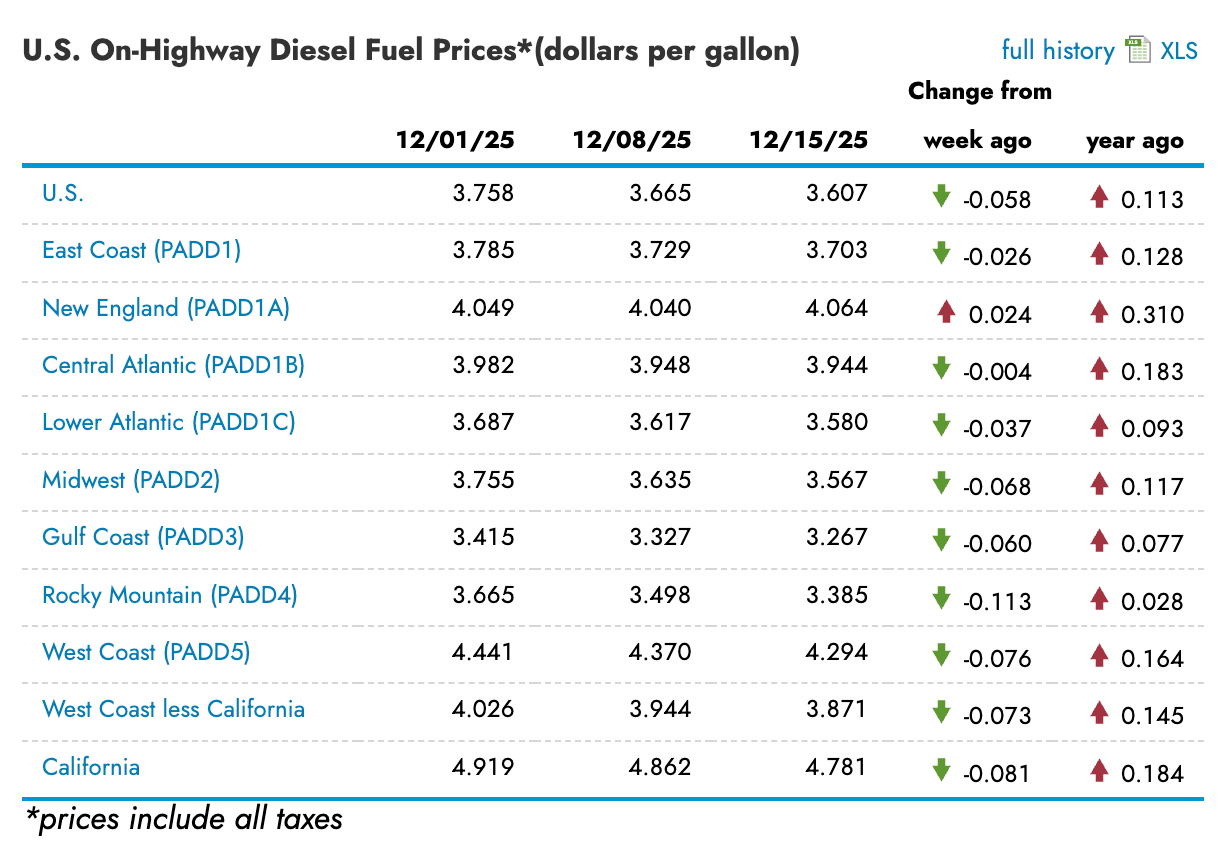
Source: EIA Gasoline and Diesel Fuel Update
Industry News & Technology Roundup
California’s DMV is signaling momentum toward allowing heavy-duty autonomous truck testing and deployment. The state opened a 15-day public comment period on revised rules, which a former FMCSA official interpreted as a sign the agency is ready to proceed. The DMV said it expects to complete rulemaking by the end of April 2026, and the revisions include replacing disengagement reporting with system-failure reporting and adding monthly and quarterly data submissions. Trucking Dive.